How Long to Wait Before Sealing New Pavers
Wait at least 60 days after installation before sealing new pavers with a film-forming, solvent-based sealer, or at least 30 days after installing polymeric sand before sealing with a water-based penetrating sealer. Either way, the surface and joints also need at least 24 hours with zero moisture immediately before you apply any sealer. Which wait applies to you depends on your sealer type and whether you used polymeric sand — not on a single number.
Key takeaways
- Film-forming solvent-based sealers: wait a minimum of 60 days after paver installation.
- Water-based penetrating sealers: wait a minimum of 30 days specifically after installing polymeric sand.
- Every sealer, regardless of type, needs at least 24 hours of completely dry, moisture-free surface right before application.
- The wait exists mainly to let new efflorescence work its way out before a sealer traps it underneath.
- Competing blogs that quote one universal number (90 days, one week) are usually mixing up these two different questions.
Why does the wait time even matter?
New concrete pavers go through a chemical process called efflorescence. As the concrete cures, calcium hydroxide forms inside it, dissolves in water, and migrates to the surface, where it reacts with carbon dioxide in the air to form a white, powdery deposit of calcium carbonate. According to the Interlocking Concrete Pavement Institute (ICPI), efflorescence “may appear immediately or within months following installation” and “may reach its peak in as short as 60 days after installation.”
If you seal the pavers before that process finishes, the sealer can trap efflorescence underneath the film, or the film itself can turn cloudy. That is the real reason manufacturers build a waiting period into their instructions — it is not an arbitrary rule.
Why do sources give different numbers?
Search for this question and you will find wait times anywhere from one week to 90 days, often stated as if they were universal. In reality, two manufacturer data sheets we checked directly give two different, specific numbers because they are answering two different questions:
- H&C ULTRAPAVER Solvent-Based Florida Paver Sealer (a film-forming, gloss acrylic-type sealer) instructs: “Allow newly installed pavers to weather a minimum of 60 days before sealing.” This is a general new-paver cure and weathering wait, not tied to polymeric sand specifically.
- Techniseal Natural Look (iN) Protector (a water-based, penetrating sealer) does not give a general new-paver number at all. Instead it says: “Wait 30 days after the installation of polymeric sand before sealing the pavers.” That is a narrower instruction about letting the sand cure, not the concrete.
A third manufacturer source corroborates the 60-day figure for film-forming, solvent-based sealers: Alliance Gator’s Wet Look Sealer technical data sheet states plainly, “Concrete pavers should only be sealed 60 days after their installation date,” and separately requires “at least 48 hours of dry conditions” immediately before application. Two independent solvent-sealer manufacturers landing on the same 60-day figure for this type of sealer is a useful confirmation, not a coincidence.
These numbers are not interchangeable answers to the same question. If you used polymeric sand and plan to apply a water-based penetrating sealer, the 30-day sand-cure clock is what applies to you. If you are using a film-forming solvent sealer on pavers with ordinary (non-polymeric) jointing sand, the 60-day paver-weathering clock applies instead.
The decision table
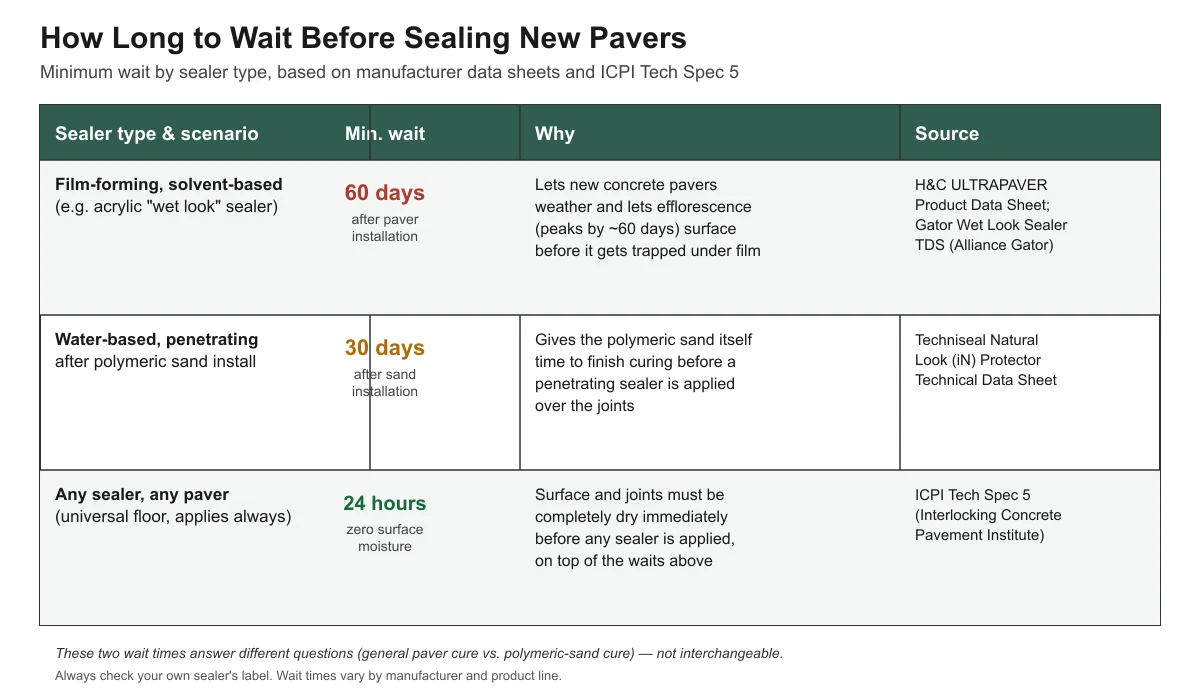
| Sealer type & scenario | Minimum wait | Why | Source |
|---|---|---|---|
| Film-forming, solvent-based (e.g. acrylic “wet look” sealer) | 60 days after paver installation | Lets pavers weather and lets efflorescence (which can peak around 60 days) surface before sealing traps it | H&C ULTRAPAVER PDS; Alliance Gator Wet Look Sealer TDS |
| Water-based, penetrating sealer, after polymeric sand | 30 days after sand installation | Lets the polymeric sand itself finish curing before sealer is applied over the joints | Techniseal Natural Look (iN) Protector TDS |
| Any sealer, any paver (universal floor) | At least 24 hours, zero surface moisture | Surface and joints must be completely dry right before application, on top of the waits above | ICPI Tech Spec 5 |
How to check if the surface is actually ready
- Confirm which wait applies: film-forming solvent sealer → count 60 days from the paver installation date. Water-based sealer over new polymeric sand → count 30 days from the sand installation date.
- Once that clock has passed, check the weather forecast: you need at least 24 hours with no rain or dampness before you seal, per ICPI’s minimum.
- Look at the surface for white, powdery efflorescence. If it is heavy, clean it off with an efflorescence remover and let the area dry at least 24 hours before proceeding — see our guide to cleaning pavers before sealing for the step-by-step.
- Touch the surface. It should be cool and dry, not damp, before you open the sealer.
What if I don’t know which wait applies to me?
If your pavers were installed with regular (non-polymeric) sand and you plan to use a film-forming, solvent-based sealer, use the 60-day figure. If polymeric sand was part of the installation and you’re using a water-based penetrating sealer, use the 30-day figure measured from the sand installation date — not the paver installation date. If you’re not sure which sealer category your product falls into, check its own technical data sheet or label; manufacturers list this explicitly, and your product’s instructions always override a general guide like this one.
Don’t combine the two numbers by adding them together, and don’t split the difference. ICPI, the neutral industry body, does not publish one fixed number at all — it only states the underlying dry-surface requirement and notes that efflorescence can take up to 60 days to peak. That is consistent with, not in conflict with, the manufacturer figures above.
What happens if you seal too early?
Sealing before efflorescence has run its course, or before the surface is fully dry, is one of the documented causes of sealer failure. ICPI explains that a sealer “may whiten” when the surface and joints are not dry, when there has not been adequate exposure to moisture cycling, when there’s an ongoing efflorescence source under the pavers, or when the sealer itself isn’t breathable enough to let trapped moisture escape. In that situation, ICPI says the sealer typically has to be removed or re-dissolved — not just touched up. For more on diagnosing whitening after it happens, see our guide to white haze on pavers after sealing, and if the film has already lifted or flaked, see paver sealer peeling or flaking: causes and fix.
How this fits into the full sealing process
Waiting the right amount of time is just one step. For the complete process — cleaning, drying, choosing a sealer, applying it without lap marks, and maintaining it afterward — see our complete step-by-step guide to sealing pavers. Once your pavers are sealed, you’ll also want to know how often to reseal them, since that answer depends on the same sealer-type distinctions covered here.
Frequently asked questions
Can I seal pavers sooner than 60 days if I’m in a hurry?
Manufacturer instructions state the minimum wait for a reason: efflorescence and moisture need time to work their way out first. Sealing earlier risks trapping efflorescence or moisture under the film, which can cause whitening or peeling later. There is no sourced “fast track” shortcut for either wait time in this guide.
Does the 30-day polymeric sand wait replace the 60-day paver wait?
No. They answer different questions. The 60-day figure is about the concrete pavers weathering; the 30-day figure is specifically about polymeric sand curing. If your situation involves both new pavers and new polymeric sand, follow whichever period is longer for your specific sealer and situation, and always defer to your sealer’s own label.
Do paver manufacturers themselves specify a wait time?
Paver manufacturers generally defer sealing timing to the sealer manufacturer’s instructions. ICPI, the industry’s technical body, declines to give one fixed number and instead explains the underlying dry-surface and efflorescence principles that any wait time is meant to satisfy.
What if it rains during my waiting period?
Rain during the waiting period itself is normal and generally not harmful — the clock is about letting the paver or sand cure, not about avoiding all moisture during that window. What matters is the separate 24-hour dry-weather requirement that applies immediately before you apply the sealer.
Is polymeric sand required before sealing pavers?
No. Many installations use ordinary jointing sand instead. If you did not install polymeric sand, the 30-day sand-specific wait does not apply to you — use the general paver-weathering wait that matches your sealer type instead.
Sources
- Interlocking Concrete Pavement Institute, Tech Spec 5: Cleaning, Sealing and Joint Sand Stabilization of Interlocking Concrete Pavement
- Techniseal, Natural Look (iN) Protector Technical Data Sheet
- H&C Concrete, ULTRAPAVER Solvent-Based Florida Paver Sealer Product Data Sheet
- Alliance Gator, Gator Wet Look Sealer Technical Data Sheet
By paversealguide.com Editorial Team. Last updated: 2026-11-13.